

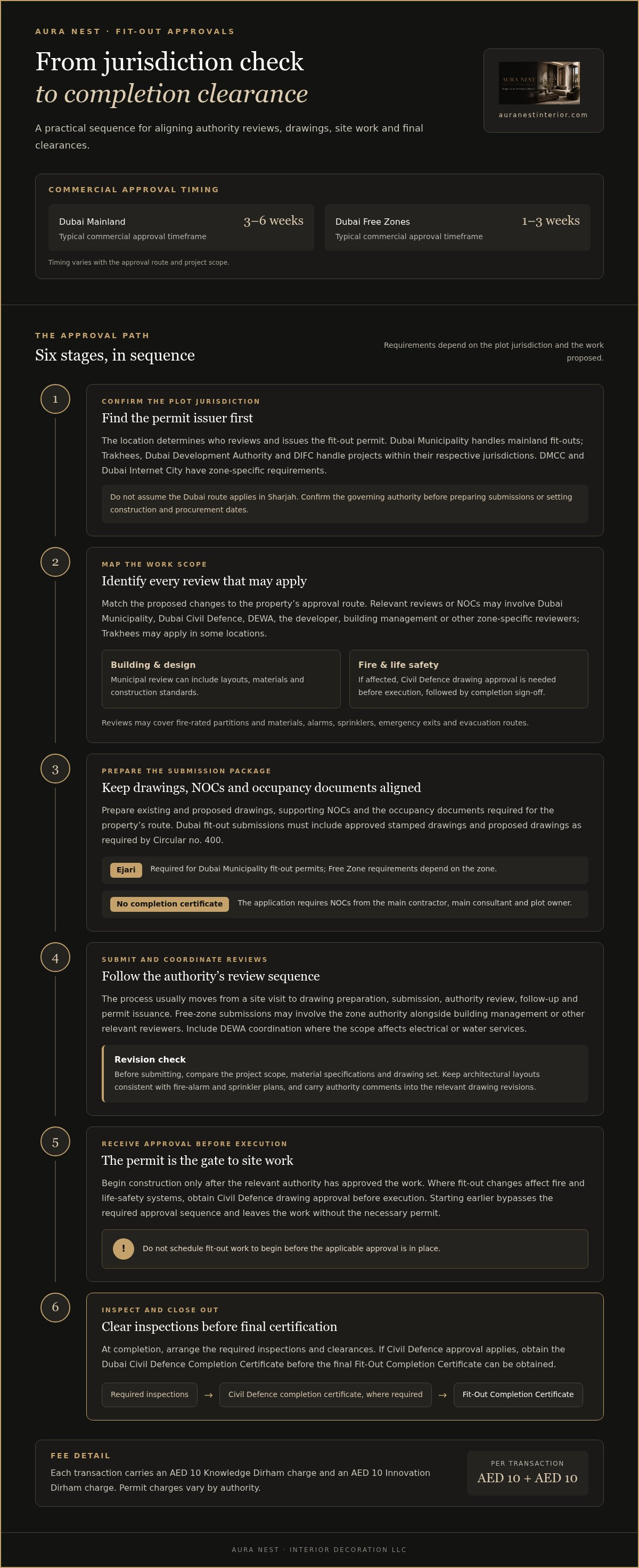
A commercial or residential fit-out must not begin until the relevant authority has approved it. Fit out authority coordination depends on the property’s location and the proposed work. Approvals or NOCs may involve municipal departments, development authorities, specialized regulatory bodies, civil defense agencies, utility providers, and the property developer. Fire and life-safety changes may also require drawing approval before work starts and completion sign-off afterward.
It is natural to expect one permit to cover an entire project. In practice, authority and developer requirements can overlap, so sequencing matters as much as the drawings. This guide explains which approvals, permits and NOCs may apply, how submissions and inspections fit together, and what clearances are needed for handover. It also explains how coordinated design and technical delivery by Aura Nest can keep approvals aligned with the fit-out work.
Key Takeaways
- Identify the property’s jurisdiction first; it determines which authority issues the fit-out permit and which NOCs may be needed.
- Match the approval route to the work scope, especially where fire and life-safety systems or layouts are affected.
- Plan for inspections and completion clearances as part of the project sequence, not as a final administrative step.
- Coordinate authority submissions with developer or mall requirements to keep drawings, site work and approvals aligned.
- Prepare the required drawings and occupancy documents for the applicable permit route before fit-out work begins.
Is Dubai Civil Defense approval required?
For Dubai Mainland fit-outs, Dubai Municipality and Dubai Civil Defence approvals are required. The approval route also depends on the property’s jurisdiction and the work involved.
Dubai Municipality reviews building and design permits, including whether layouts and materials meet construction standards. A project may also need approvals or NOCs from DEWA, the developer and, in some locations, Trakhees. Map these requirements against the tenancy location and proposed drawings before scheduling site work. A residential refresh and a commercial layout change may involve different reviews.
Dubai Civil Defence focuses on fire and life safety. If fit-out work affects those systems, its drawing approval is required before execution, followed by completion sign-off. Reviews may cover fire-rated partitions and materials, alarms, sprinklers, emergency exits, evacuation routes and relevant technical specifications. For example, changing a partition layout can affect both the escape route and the fire-protection details shown on the drawings.
Common Approval Delays and Rejections
Delays often happen when submitted drawings do not match the proposed work, documents are incomplete, or authority comments are not incorporated into the next submission. Differences between architectural layouts and fire alarm or sprinkler plans can also lead to revisions. Before submitting, compare the drawing set, material specifications and project scope. Then link each authority comment to the relevant drawing revision instead of treating approvals as separate paperwork.
Projects in Dubai and Sharjah may involve multiple authority submissions, document reviews and site inspections. The responsible bodies differ by location, so do not assume a Dubai approval route applies in Sharjah. Confirm the plot jurisdiction first, then identify the permit issuer and any additional reviewers. This helps expose overlapping requirements before construction dates and procurement are set.
Required Fit-Out Permits
The permit package depends on the property and proposed changes. Dubai fit-out applications require NOCs from relevant authorities. Dubai Municipality fit-out permits require Ejari registration, while Ejari requirements in Dubai Free Zones depend on the zone. For buildings without a completion certificate, applications require NOCs from the main contractor, main consultant and plot owner.
Prepare the existing and proposed drawings, then submit them through the authority responsible for the site. If the work affects fire and life-safety systems, include the relevant technical drawings for Civil Defence review before execution. Begin construction only after the relevant authority has approved the work. At completion, arrange the required inspections and Civil Defence sign-off before applying for the Fit-Out Completion Certificate. This sequence connects regulatory approval with site work and final clearance.
Need Fitout Approvals / Permit / NOC for your project in Dubai?
Start by confirming the plot jurisdiction, then match the proposed interior fit-out to the relevant approval route. The permit issuer, required NOCs, drawings and fees depend on the site and scope.
Plot Jurisdiction and Permit Authorities
Jurisdiction determines which body reviews and issues the fit-out permit. Dubai Municipality handles mainland fit-outs; Trakhees, the Dubai Development Authority and DIFC handle projects within their respective jurisdictions. DMCC and Dubai Internet City also have zone-specific requirements. Identify the plot’s governing authority before preparing submissions, because a permit from the wrong authority will not cover the project.
Free-zone coordination follows the zone’s own approval requirements. DMCC or DIFC submissions may involve their zone authority as well as building management or other relevant reviewers. Commercial approvals typically take 3-6 weeks for Dubai Mainland and 1-3 weeks in Dubai Free Zones. The route and scope influence the sequence.
Permit Applications and Completion
The process usually moves from a site visit to drawing preparation, submission, authority review, follow-up and permit issuance. A Dubai fit-out permit application requires NOCs from relevant authorities. For a building without a completion certificate, the application requires NOCs from the main contractor, main consultant and plot owner.
Begin construction only after approval from the relevant authority. Starting earlier bypasses the required approval sequence and leaves the work without the necessary permit. At completion, arrange required inspections and clearances before applying for the Fit-Out Completion Certificate. The Dubai Civil Defence Completion Certificate is required before the final fit-out certificate can be obtained.
DEWA Fit-Out Approvals
DEWA, the Dubai Electricity and Water Authority, may be involved in fit-out approvals. Its role depends on the project scope and the services affected. Align electrical and water-related work with the relevant technical drawings and approval route. Where required, include DEWA coordination in the submission schedule rather than treating utility interfaces as separate from the interior fit-out.
Submission Drawings and Documents
Prepare existing and proposed drawings, supporting NOCs and occupancy documents required for the property’s route. Dubai fit-out submissions must include approved stamped drawings and proposed drawings as required by Circular no. 400. Ejari registration is required for Dubai Municipality fit-out permits, while Free Zone Ejari requirements depend on the zone.
Permit charges also vary by authority. Each transaction also carries AED 10 Knowledge Dirham and AED 10 Innovation Dirham charges. Map the jurisdiction, NOCs, drawings and fees together for a more efficient submission. For projects that pair design with execution, turnkey interior fit-out can align those workstreams.
Authority inspections and final clearances
Inspections compare the approved drawings with the work completed on site. For Dubai fit-out projects, keep installed layouts, finishes and building services consistent with the approved scope. This makes it easier to address authority comments against the relevant drawing or installation, rather than treating each inspection as an isolated visit.
Plan inspections around the project’s permit conditions and the systems affected. A partition change can alter an evacuation route, while ceiling work may intersect with alarms or sprinklers. Flooring, lighting, mechanical, electrical and plumbing works should also match the coordinated interior layout. Record completed work and outstanding items by area so the site team can prepare specific responses if an inspector finds a discrepancy.
For a Dubai project affecting fire and life safety, Dubai Civil Defence approves drawings before execution and provides completion sign-off afterward. Its review may cover fire-rated materials, alarms, sprinkler systems and evacuation planning. Keep the approved fire-safety drawings on site and compare them with installed conditions. If a system or layout differs, resolve the discrepancy through the required approval route before considering the work complete.
Practical inspection preparation includes several coordinated checks:
- Compare completed partitions, doors and escape routes with the approved plans.
- Review alarm and sprinkler installations against the approved fire-safety drawings.
- Check that specified fire-rated materials and partitions match the project documents.
- Organise the relevant approvals, inspection records and revised drawings for review.
These checks help identify unfinished or inconsistent work before an authority visit. They also give the site team a clear record of which areas are ready, which comments remain open and who is responsible for each corrective action. In a free zone, include the zone’s permit conditions and building-management requirements in the same inspection register. The permit route identifies the reviewers; the project record connects their comments to the site work.
Final clearance is a sequence, not a single sign-off. Dubai fit-out works require a Dubai Civil Defence Completion Certificate before a Fit-Out Completion Certificate can be obtained. Schedule the required inspections, close recorded comments and keep the resulting clearance documents together. A practical handover file should include approved drawings, completion records and final certificates, giving the owner and building management a clear approval trail.
For fit-out projects involving several trades, coordinate inspection readiness with material coordination, manpower planning, quality checks and timeline tracking. Update the inspection register whenever the work changes, and identify the affected drawing before requesting a review. This process helps align regulatory requirements, site delivery and final clearances.
Coordination across Dubai authorities and developers
A Dubai fit-out may involve a zone authority, building management, a developer and specialist reviewers. Their requirements can overlap, but each party reviews a different part of the project. DIFC, DMCC and Dubai Internet City have zone-specific approval requirements. Mall projects also require mall management approval alongside the relevant authority permit. Effective fit out authority coordination in Dubai aligns these reviews around accurate layouts and project information.
Start with a responsibility schedule for the property. List each reviewing party, the submission and drawing or document it requires, and who will follow up. For a mall unit, record the mall management review separately from the authority permit. For a DMCC office, map the zone’s requirements alongside building procedures. This makes dependencies visible before procurement or site sequencing relies on an approval.
Keep the approval process organised with one controlled drawing set. If a developer requests a layout revision, record the change and identify the authority submissions it affects. A revised partition plan, for example, may also change lighting, mechanical services or fire-safety information. Reconcile these interfaces before resubmitting, rather than letting each package show a different scheme. Clear revision labels help reviewers distinguish current layouts from superseded documents.
Use a comment register to coordinate feedback from all parties. For each comment, record its source, the drawing affected, the response and the next action. If the zone authority comments on access while building management raises delivery or site rules, keep both items visible. Resolve conflicts against the property’s requirements and the intended fit-out scope. This prevents a closed comment from being mistaken for approval of unrelated work.
- Set a named owner for each authority and developer submission.
- Track review comments against drawing numbers and revision dates.
- Align site access, material deliveries and inspection readiness with building procedures.
- Update the programme when a reviewer requests a change affecting another submission.
Delays often occur at the interfaces between reviews, rather than within a single review. A mall approval may depend on layouts that are also part of an authority submission. A change requested by one reviewer can affect another party’s assessment. Make these dependencies clear, then sequence submissions and responses accordingly. One approval does not replace separate consent required from another reviewer.
Manage fit out authority coordination in Dubai as an active project workstream. Keep the approval schedule current, distribute the same revised layouts to the relevant parties, and close each comment with a documented response. This gives the project team a clear view of outstanding approvals and helps align design decisions, site activity and handover.
What permits are required for a Dubai fit-out project?
Required permits depend on the plot, property jurisdiction and proposed work. Distinguish the authority fit-out permit from supporting NOCs, developer approvals and requests triggered by the project scope.
For Dubai Mainland, Dubai Municipality issues fit-out permits. Within their respective jurisdictions, permits are handled by the Dubai Development Authority, Trakhees and DIFC. A mall unit also requires mall management approval alongside the relevant authority permit. Identify the plot’s authority and building requirements first. This establishes which submissions apply before preparing the drawing package.
- Authority fit-out permit: Apply through the permit issuer for the property’s jurisdiction.
- Supporting NOCs: Include NOCs from relevant authorities. A building without a completion certificate requires NOCs from its main contractor, main consultant and plot owner.
- Fire and life-safety approval: Where work affects fire safety, obtain Dubai Civil Defence drawing approval before execution and completion sign-off afterward.
- Building or mall consent: Add developer or mall management approvals where the property’s process requires them.
Occupancy documents also matter. Ejari registration is required for Dubai Municipality fit-out permits. In Dubai Free Zones, Ejari is not always mandatory; requirements depend on the zone. DIFC, DMCC and Dubai Internet City have zone-specific approval requirements, so a mainland submission checklist cannot simply be applied to a free-zone unit. Match the documents to the property’s approval route.
The scope may require a different application. If the proposal adds structural elements, changes the building’s use or adds GFA, submit a Building Modification request. Make this distinction before choosing the fit-out permit route. A project changing only interior finishes is not the same as one changing the building’s use or floor area.
Prepare the drawings and supporting documents around the selected permit. Dubai fit-out submissions must include approved stamped drawings and proposed drawings as required by Circular no. 400. Keep the submission aligned with the proposed work, including relevant technical details. If revisions alter the scope, update the affected drawings and approvals before proceeding with those changes.
For completion, follow the authority’s inspection and clearance sequence. Dubai fit-out works require a Dubai Civil Defence Completion Certificate before a Fit-Out Completion Certificate can be obtained. Organise closeout documents alongside the final approved drawings, inspection records and required clearances. This creates a traceable handover instead of leaving approvals scattered across project files.
Set the permit route before finalising layouts. Plan your interior design around the property’s approval requirements and the intended scope of work.
Aura Nest: Interior Design
Aura Nest brings interior design and technical delivery together for projects where approvals shape the design decisions. Its work includes 3D design visualisation, authority coordination and turnkey execution, helping align proposed layouts with the project’s delivery requirements. Turn to Aura Nest for interior design, villa renovation and fit-out, apartment and penthouse renovation, or a turnkey fit-out. This is a practical next step when you want design intent, joinery and technical coordination considered as connected parts of the project, rather than separate decisions.
Share your project brief and property details to discuss the next step. Visit auranestinterior.com to contact Aura Nest.
Set the Project Up for a Clear Next Step
The strongest next move is to bring the design intent and approval pathway into the same project conversation. Fit-out authority coordination in Dubai is easier to plan when the proposed scope, property requirements and delivery decisions are considered together, before those choices become difficult to revise.
Aura Nest offers Interior Design, Villa Renovation & Fit-Out, and Turnkey Interior Fit-Out. Its design visualisation, authority coordination and technical delivery help connect the project brief with the work required to realise it. Whether you are planning a villa renovation or a complete interior fit-out, start with a clear outline of the property, intended changes and priorities.
Contact Aura Nest about your fit-out to discuss a considered next step for your project. A clear brief is a strong foundation for bringing the design and delivery into alignment.
Frequently Asked Questions
Can fit out work start without approval?
No. Fit-out construction in Dubai must begin only after approval from the relevant authority. Starting early can leave completed work outside the approved scope and complicate inspections or later clearance. For example, if site work changes a submitted partition layout, the drawings and approval may no longer reflect the installed condition. Set the start date after the required permit and applicable approvals are in place.
How can fit-out work be done without disrupting business operations?
Plan the work in phases and coordinate each phase with business access and essential operations. In an occupied office, group disruptive tasks into agreed work windows, protect active areas and maintain a clear route for staff and deliveries. Track manpower, materials, quality checks and programme changes together. If a phase affects shared services or circulation, coordinate the sequence with building management before moving the worksite.
What about Civil Defence and consultant sign-off?
Dubai Civil Defence approval is required for most commercial spaces to address fire safety. Fire or life-safety changes require drawing approval before execution and completion sign-off afterward. A consultant may also be part of the NOC route: for a building without a completion certificate, the fit-out application requires NOCs from the main contractor, main consultant and plot owner. Keep each party’s role distinct in the approval record.
Which Dubai authorities approve commercial fit-out works?
The property’s jurisdiction determines the permit issuer. Dubai Municipality handles mainland fit-outs, while Trakhees, the Dubai Development Authority and DIFC handle permits within their respective jurisdictions. DEWA, Dubai Civil Defence, the developer or mall management may also be involved, depending on the project and building. For a mall unit, mall management approval is required in addition to the relevant authority permit.
How do Dubai Municipality fit-out approvals work?
For a mainland project, prepare the Dubai Municipality fit-out submission with the required proposed and approved stamped drawings. Ejari registration is required for a Dubai Municipality fit-out permit. The authority reviews the submission against the proposed work and applicable construction standards. Keep the layouts consistent with the planned site work, since changes to partitions, finishes or services may require corresponding drawing updates.
When is Dubai Civil Defence approval required for fit-out works?
Dubai Civil Defence approval addresses fire safety in most commercial spaces. It is required before execution when fit-out work affects fire and life-safety provisions, with completion sign-off afterward. This may include changes to fire-rated partitions, alarm or sprinkler systems, and evacuation routes. For example, a layout revision affecting an exit path should also appear in the relevant fire-safety drawings for review.
What is the step-by-step Dubai fit-out approval and NOC process?
Start by identifying the property’s permit authority and the NOCs required for its building. Arrange a site visit, prepare the drawings and supporting documents, then submit them for review. Track authority comments and update affected documents before resubmitting. Once the permit is issued, begin the approved work, arrange required inspections, close outstanding comments and assemble completion clearances. This sequence keeps site activity tied to the current approved scope.
How long do Dubai fit-out authority approvals take?
Commercial fit-out approvals typically take approximately 1 to 3 weeks, depending on authority and project scope. Dubai Mainland interior design and fit-out approvals typically take 3-6 weeks, while Dubai Free Zone approvals are typically issued within 1-3 weeks. The review route, document completeness and scope influence timing. For example, revisions requested across different drawing packages can extend the approval sequence before work can proceed.

